From a 1 Million VND 'Tuition Fee' on GCP to Learning AWS from First Principles
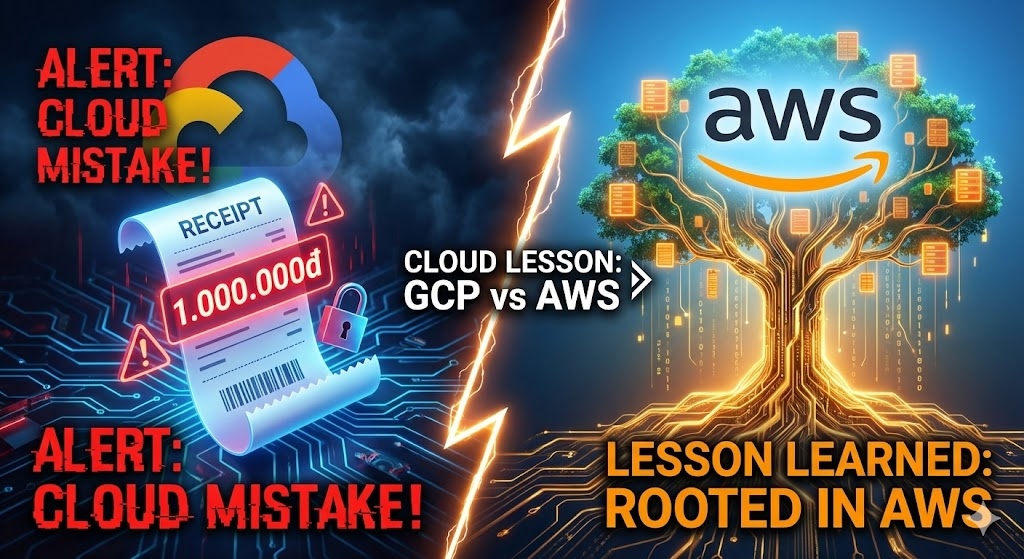
The painful overnight billing shock that cured my reckless click-ops habit and pushed me to master Cloud Architecture from First Principles.
Topic: Why I chose to master “dry” Cloud Architecture theory before touching the AWS Console.
Author: A developer whose hands used to move faster than his brain.
1. The 1,000,000 VND Click and the Most Expensive 12 Hours of Sleep in My Life
I never imagined my journey into AWS (Amazon Web Services) would begin with a disaster on… Google Cloud (GCP). Yet that is exactly where I paid my most unforgettable cash “tuition fee” in Cloud Computing.
Back then, I needed to deploy a seemingly tiny automated image-processing script (Cloud Function). With the casual confidence of someone used to writing code on a personal laptop, I clicked deploy, saw the green check-mark, triggered a test run, and… turned off the lights and went to bed.
What I didn’t realize was that I had just wired an Infinite Trigger Loop:
- Whenever a new file landed in my storage folder (Bucket), the cloud automatically woke up my Function to process it.
- Once finished, my Function saved the processed file… right back into that exact same Bucket.
- The Bucket saw a newly saved file, assumed a customer had just uploaded something new, and immediately woke up another copy of my Function!
If you make an infinite loop on your personal laptop at home, the cooling fan roars, the screen freezes, and you hold down the power button to reboot — total cost: $0.
The Cloud, however, is engineered to never get tired. When it saw thousands of new events piling up per second, it dutifully said: “Yes sir! Let me rent 500 more servers in parallel so we can finish all this work for you!” For 12 straight hours while I slept peacefully, the billing meter spun like a taxi hurtling down the highway at 200 km/h.
When I woke up and checked my phone, my inbox was screaming with billing alerts: 1,000,000 VND had vanished overnight.
Click ”⚡ Simulate 12 Hours Overnight” in the interactive simulator below to watch how the cloud billing meter behaves across 3 stages of architectural maturity:
On your personal laptop, if your code gets stuck in an infinite loop, your fan spins loudly, the screen freezes, and you just restart the computer for $0. On the Cloud, an infinite loop tells Amazon or Google: 'Please rent 500 more computers immediately to handle all this work!' While you sleep peacefully for 12 hours, the meter keeps running like a taxi driving at 200 km/h.
Zero billing alarms + zero concurrency limits + recursive event trigger = 1,000,000 VND burned in 12 hours.
The 1,000,000 VND Infinite Trigger Loop
Deploying code without understanding cloud event loops
One million VND (~$40 USD) might sound small to an enterprise, but out of my own pocket back then, it was a stinging price to pay for “clicking first and thinking later.” From that morning onward, as I transitioned to learning AWS, I made a vow: no more blind trial-and-error. I would learn Cloud from First Principles — understanding the underlying foundation before typing a single command.
2. What Does “First Principles Thinking” Mean in the Cloud?
Think about building a house:
- The “Copy-Paste Tutorial” Approach (Top-down): You want a nice bedroom → you watch a 5-minute YouTube video titled “How to Stack Bricks Fast” → you stack bricks on bare mud and paint them a pretty color. It looks finished in an afternoon, until the first heavy rain washes the whole wall away because there was no foundation underneath.
- The “First Principles” Approach (Bottom-up): Before laying a single brick, you study how deep the concrete foundation must go, where the underground water pipes run, and where to install the circuit breaker (fuse box) so an electrical short trips a switch instead of burning down the house.
In AWS, clicking buttons in the web console (Click-ops) is just the visible coat of paint — the top 10% of the iceberg. The hidden 90% — what keeps your system online during traffic spikes, locked tight against hackers, and physically incapable of burning your bank account while you sleep — lives in the architectural principles underneath.
3. The Foundation Blueprint: What I Mastered Before Launching My First Server
Instead of spinning up virtual machines on day one, I grabbed pen and paper and sketched out the 3 foundational pillars of Cloud infrastructure. Even if you aren’t a cloud specialist, you can picture them through everyday real-world analogies:
A. Global Infrastructure: The “Bank Branch” Analogy
I used to think terms like Region and Availability Zone (AZ) were just abstract labels in a dropdown menu. Once I looked at the physical reality, everything clicked:
- Region (Geographic City): A major metropolitan hub around the world (e.g., Singapore, Tokyo, Northern Virginia).
- Availability Zone - AZ (Isolated Data Center Cluster): Inside each Region, Amazon doesn’t build one giant building. Instead, it builds multiple independent data center complexes miles apart, each on separate power grids and flood plains. If a flood or blackout hits District A, the data center in District B keeps humming.
- The Price of Distance: Spreading your app across two Availability Zones (Multi-AZ) means your website stays alive even if an entire data center goes dark — but every gigabyte of data traveling across fiber-optic cables between those two buildings costs latency and money. Resilience in the cloud always has a price tag.
B. Networking & IAM: Never Put Your Bank Vault on the Sidewalk!
- VPC (Virtual Private Cloud — Your Private Walled Compound): Imagine leasing a plot of land in the cloud and building a security perimeter around it. Inside, you divide the space into two zones:
- The Front Lobby (Public Subnet): Where the receptionist (Load Balancer) greets visitors arriving from the public Internet.
- The Windowless Vault Room (Private Subnet): Where your customer database lives. This room has zero doors leading directly to the outside street!
- IAM (Identity and Access Management — The Security Guard & Keycard System): Every person and every piece of code gets a keycard with Least Privilege (the bare minimum permissions needed to do its job). Had I configured an IAM keycard on GCP that allowed my Function to read from the Input Bucket but strictly forbade writing back to that same Input Bucket, my 1,000,000 VND infinite loop would have been stopped dead at second #1!
C. Compute & Storage: Monthly Apartment Lease vs. Metered Taxi Ride
- Choosing Compute (EC2 vs. Lambda):
- EC2 (Virtual Servers): Like signing a monthly apartment lease. Whether you sleep there all night or leave the room empty, you pay a fixed, predictable hourly/monthly rate.
- Lambda (Serverless Functions): Like hopping into a metered taxi that charges per millimeter of wheel rotation. When the car is parked, you pay $0.00. It’s magical — unless the driver gets stuck driving in circles around a roundabout all night while you’re asleep!
- Choosing Storage (EBS vs. S3):
- EBS (Block Storage): A high-speed hard drive bolted directly onto a computer to run operating systems and databases.
- S3 (Object Storage): A massive, dirt-cheap warehouse built to store millions of photos, videos, and backups. Understanding the difference ensures you never make the rookie mistake of trying to run a live relational database on top of S3.
4. Installing the Fuse Box First: My Deliberate Study Routine
Because my day job still revolved around GCP, I turned my AWS study into a disciplined engineering lab:
- Rule #1 — Wire the Billing Alarm Before Anything Else: The very first thing I do inside a fresh AWS account isn’t creating a server — it’s opening AWS Budgets & CloudWatch Alarms and setting a hard tripwire: “If my monthly bill crosses $5 USD, blast an alert to my email and phone immediately!” That 1M VND scar taught me never to trust human memory.
- Mental Modeling on Paper: Before clicking anything, I challenge myself: “If I had to migrate our company’s production system from GCP to AWS today, which doors would a user request pass through? If one server dies, who catches the traffic?” If I can’t draw it on a blank sheet of paper, I don’t understand it yet.
- Reading the AWS Well-Architected Framework: Instead of watching “Deploy a Website in 5 Minutes” videos, I studied Amazon’s official architectural whitepapers. They may look dry at first glance, but they train you to think like a structural engineer rather than a button-pusher.
5. Scenario-Driven Practice: Mastering Real-World Combos
In the real world, no cloud service stands alone. Every real product is a carefully wired combination of building blocks:
- Combo 1 — The Cost-Protected Serverless Backend: API Gateway (Front door) → Lambda (Business logic) → DynamoDB (Fast database) + CloudWatch (Security cameras). Here I practiced locking down maximum concurrency limits and strict IAM permissions so runaway loops are physically impossible.
- Combo 2 — Global High-Speed Website Delivery: S3 (Static file storage) + CloudFront (Global edge cache servers close to users) + Route 53 (DNS traffic director) + ACM (Free HTTPS SSL certificates).
- Combo 3 — Zero-Downtime Database Migration: RDS Multi-AZ + AWS DMS over private VPC Peering, syncing live data behind the scenes so customers never experience a maintenance outage.
💡 An Unexpected Bonus for a Self-Taught Engineer: Coming from a non-CS background, dissecting these architectural scenarios forced me to fill in foundational computer science gaps I had skipped years ago: how
TCPvs.UDPpackets behave, whyExponential Backoff and Jitterprevents cascading server crashes, and howNAT Gatewayslet private servers download security updates without exposing themselves to the public internet.
6. Putting It All Together: Rebuilding an Old System with a Radically Different Bill
Once the mental blueprint was solid, I rebuilt the cloud architecture of an older project from scratch on AWS:
- An Application Load Balancer spanning two Availability Zones (Multi-AZ) in the public lobby.
- Stateless EC2 workers tucked safely inside a Private Subnet, scaling automatically with real customer traffic.
- An Aurora database cluster running in Multi-AZ mode with automated failover.
- Background jobs handled by Lambda, fenced in by strict IAM roles, concurrency caps, and CloudWatch Alarms.
Compared to my old “hands faster than brain” days of wide-open security groups and unguarded event triggers, the new architecture was not only resilient against data-center outages — its projected monthly bill was a fraction of the cost, with zero possibility of an overnight billing nightmare.
7. Final Thoughts: Slow Down So You Don’t Pay in Cash
Starting with architectural theory and first principles might look slow in an era where everyone wants instant 5-minute tutorials. But as someone who watched 1,000,000 VND evaporate overnight from a single careless event loop, I learned a timeless truth: In the Cloud, ignorance is billed directly to your credit card.
Cloud consoles will redesign their menus next year, and services will get new marketing names, but the first principles of networking, least-privilege security, physical latency, and circuit-breaker limits never change. Mastering those fundamentals is the exact moment you stop being a tutorial copy-paster and become a real Systems Engineer.
Don’t wait for a screaming morning billing alert to teach you how your infrastructure actually works. Trust me — once is more than enough!