Angular's Architectural Advantage in the AI Era
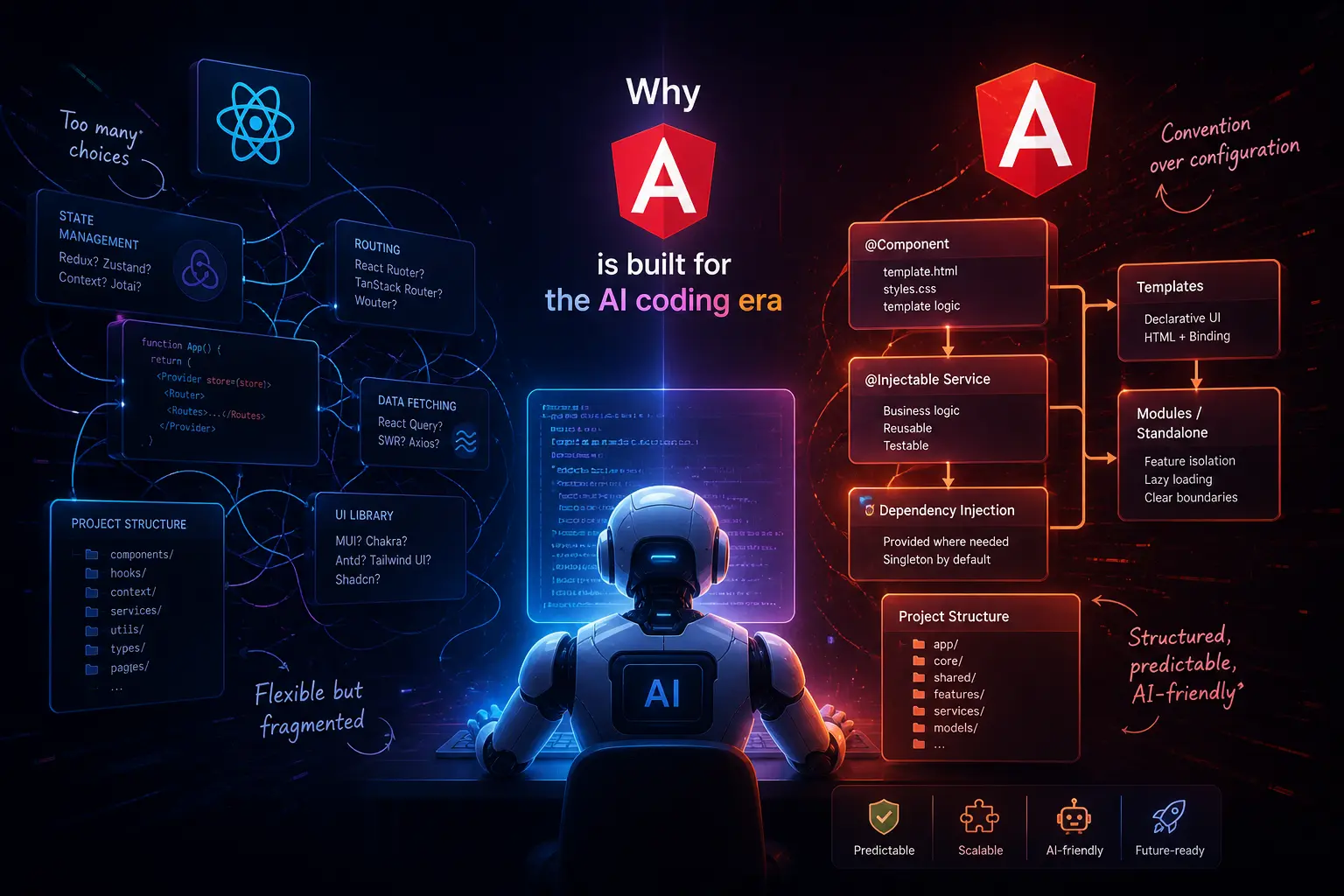
React's unopinionated freedom was a paradise for human developers, but for probabilistic AI agents it turns into an architectural lottery. Here is why modern Angular's standardized steel rails are becoming the ultimate AI advantage.
When you ask an AI coding assistant like Cursor, Copilot, or Claude to “Build a shopping cart and authentication flow” inside a React project, you don’t just get code — you get a spin on an architectural roulette wheel.
- On Monday, the AI picks
Reduxfor state management; on Tuesday, in the very next folder, it reaches forZustandor rawContext. - In one component it fetches data inside a raw
useEffect(fetch), while in another it usesReact Query. - Half the imports assume Next.js
Pages Router, while the other half assumeApp Router.
To put this in plain English for non-specialists: The unopinionated freedom that made React rule the manual human-coding era is becoming its biggest liability in the AI era.
Conversely, Angular’s strict, “batteries-included” philosophy — especially after its modern renaissance — has suddenly turned into the ultimate set of standardized steel rails for high-speed AI code generation!
Switch between all 3 Framework Paradigms in the interactive simulator below to see what happens when you ask an AI agent to build a house on React’s open lot versus modern Angular’s standardized blueprint:
React gives human developers total freedom: there is no official router, no official data-fetching library, and 5 different ways to store state. That freedom was fun for humans, but for a probabilistic AI agent, it's a trap! Ask AI to build 3 screens on 3 different days, and it will mix Redux in Room 1, Zustand in Room 2, and raw useEffect in Room 3—creating a Frankenstein house!
Giving AI an Empty Lot with 50 Different Brick Styles
1. The Hidden Cost of “Infinite Freedom” When Working with Probabilistic AI
Imagine hiring a super-fast robot contractor to build a house:
- The Unopinionated React Model (An Empty Lot): React only hands you bricks for the walls; for plumbing, wiring, roofing, and doors, it tells you to pick from 1,000 competing third-party brands at the hardware store. When human engineers work together, they hold meetings to agree on team conventions.
- Why AI Struggles Here: An AI coding model is a probabilistic engine trained on millions of public GitHub repositories. Because every React project on Earth wires its libraries differently, an unguarded AI blends incompatible patterns from its training data — installing British 3-prong outlets in the living room, American flat outlets in the bedroom, and Japanese plumbing in the kitchen!
In practice, to make AI write consistent React code, you have to spend hours acting as an “architecture nanny” — writing massive .cursorrules files, pinning strict prompts (“Use Zustand, never use Redux; use TanStack Query, never fetch inside useEffect”), and policing every pull request. You are forced to manually construct the guardrails that the framework chose not to include.
2. Why AI Agents Thrive on “One Canonical Way”
To get 100% first-try accuracy out of an AI coding agent, you don’t want a framework that offers ten ways to do one thing. You want a framework that defines one canonical, official way for every core task:
- One official way to handle routing and navigation guards (
@angular/router). - One official way to wire services together (
Dependency Injection). - One official way to make HTTP requests (
HttpClient) and validate complex forms (Reactive Forms).
That is exactly what Google’s Angular has provided for over a decade. So why did so many developers avoid Angular in the past? Because historically, its bureaucracy was exhausting to type by hand!
3. The Angular Renaissance (v17–19+): Dropping the Paperwork, Keeping the Rails
Historically (Angular v2 through v15), building even a simple counter button required registering verbose @NgModule files and wiring heavy RxJS BehaviorSubject streams. It felt like filling out five pages of municipal permits just to screw in a lightbulb.
Then came the Angular Renaissance (v17–19+), which re-engineered the framework from its core. By introducing Standalone Components and fine-grained Signals, Angular achieved the lean, minimalist ergonomics and blazing reactivity of Svelte or SolidJS — without giving up a single inch of its architectural discipline!
Compare the heavy bureaucracy of old Angular with the crystal-clear simplicity of modern Angular:
// 🔴 BEFORE (Verbose NgModules & Heavy RxJS Boilerplate)
@NgModule({
  declarations: [CounterComponent],
  imports: [CommonModule]
})
export class AppModule {}

export class CounterComponent {
  count$ = new BehaviorSubject<number>(0);

  increment() {
    this.count$.next(this.count$.value + 1);
  }
}
// 🟢 NOW (Standalone Components & Signals — Zero Boilerplate!)
@Component({
selector: 'app-counter',
standalone: true,
template: `<button (click)="increment()">Count: {{ count() }}</button>`
})
export class CounterComponent {
count = signal(0); // Clean, fine-grained reactive state
increment() {
this.count.update(c => c + 1); // Direct update, zero memory leaks
}
}The tedious boilerplate vanished, yet the structural steel rails underneath remained intact.
4. The AI Synergy: Winning on the First Prompt
Because Angular is unapologetically opinionated, the AI never has to guess.
When you prompt: “Create an authentication guard that checks the user session and redirects unauthenticated visitors to /login”, an AI writing modern Angular knows the exact blueprint immediately:
- It writes a functional
CanActivateFn. - It imports the official
@angular/router. - It accesses your auth state via the built-in
inject()Dependency Injection primitive.
There is virtually zero ambiguity. Because 90% of Angular codebases share the exact same structural DNA, the AI’s training weights align seamlessly with your production repository. The framework itself acts as a built-in prompt engineer, letting your AI agents sprint at full speed without derailing.
5. Conclusion: The AI Era Belongs to Disciplined Architecture
To be clear, React’s massive ecosystem and cross-platform reach (like React Native) aren’t going anywhere — and with disciplined human guardrails, React remains a powerhouse.
Yet as AI agents take over the heavy lifting of writing implementation code, our job as software engineers is shifting from “how fast can I type a component?” to “how predictably can an AI generate a 100,000-line system that stays coherent and maintainable?”
In this new era, strict architectural boundaries aren’t handcuffs — they are leverage. And right now, modern Angular offers some of the strongest architectural leverage in frontend engineering.