AI Is No Longer Just a Tool — The Shift Toward Infrastructure
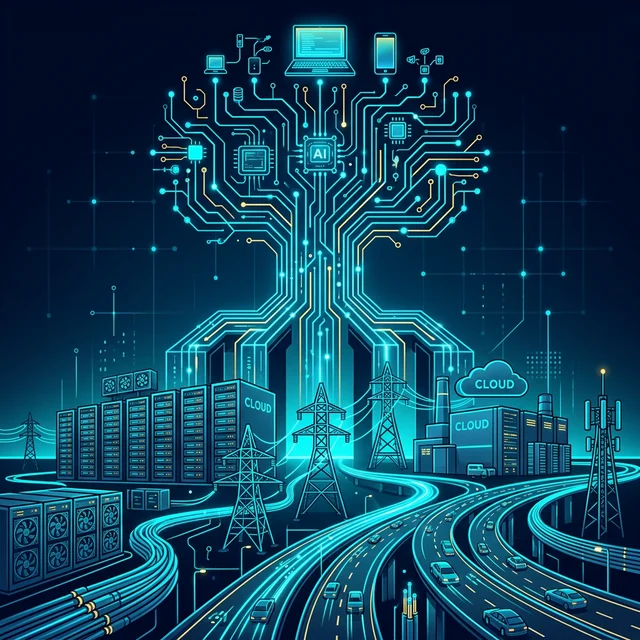
From opening a chatbot tab in 2023 to plugging into a 'National Power Grid' in 2026: why hundreds of billions of dollars are flowing into underlying AI infrastructure, and what it means for builders.
Remember 2023? Back then, everyone treated ChatGPT, Midjourney, and Copilot like a shiny new “pocket gadget.” Whenever you needed to draft an email, translate an article, or generate a snippet of code, you opened a browser tab, typed a prompt, copied the answer, and closed the tab.
Stepping into 2025–2026, however, a much deeper tectonic shift is underway: AI is no longer an “app” you open and close — it is sinking beneath the surface to become INFRASTRUCTURE, just like the electrical grid, municipal water pipes, highways, or fiber-optic internet.
You don’t “open an electricity app” to use electricity — you plug into the wall socket and build entire factories on top of that grid.
Explore all 3 Eras of AI Evolution in the interactive simulator below to see how the industry moved from standalone portable generators in 2023 to a three-tier National Power Grid in 2026:
In 2023, using AI was like buying a small portable gas generator. Whenever you needed light, you pulled the cord (opened a browser tab), typed a question into ChatGPT, copied the answer, and turned it off. Useful, but disconnected from your company's core wiring.
Token Cost: High • Usage Volume: Low (Human typing speed)
The Portable Generator Era (Chatbots as Apps)
1. Why Is AI Moving from the “App Layer” Down into the “Power Grid”?
To put this in everyday terms for non-specialists, think back to the history of electricity a century ago:
- The Early Days: If a factory owner wanted electric light, they had to buy their own noisy, smoke-belching diesel generator and bolt it in the backyard.
- The Grid Era: Massive hydroelectric and thermal power plants were built miles away, connected by high-voltage transmission lines. Any new business could simply plug into a wall socket and get instant, reliable power!
AI is following that exact historical trajectory:
- Instead of every startup spending tens of millions of dollars training a custom model from scratch, frontier labs (OpenAI, Google, Anthropic, Meta) built massive “Intelligence Power Plants” (Foundation Models).
- Companies now wire directly into that grid (
APIs&MCP) to power autonomous workflows across their entire organization.
The Billing Shock (“The AI Infrastructure Reckoning”)
Yet a fascinating economic plot twist — which Deloitte dubbed “The AI Infrastructure Reckoning” — hit enterprises hard over the past year: Even though the price per AI token dropped 280× compared to two years ago, corporate AI bills are still exploding!
How can something become 280 times cheaper per unit and still bankrupt your budget? In economics, this is known as Jevons Paradox:
- In 2023 (when tokens were expensive), usage was bottlenecked by human fingers typing a few dozen chat prompts per day.
- In 2026 (when tokens are cheap), companies deployed thousands of autonomous AI agents running 24/7 in the background — reading millions of invoices, triaging support tickets, and optimizing supply chains every second without a human clicking a button. Unit cost dropped 280×, but total consumption surged 10,000×!
That billing shock forced companies to realize that renting 100% of their AI compute from public cloud APIs is like running a heavy steel mill on retail hotel electricity. In response, smart organizations are moving to 3-Tier Hybrid AI Infrastructure:
- Public Cloud Grid: Frontier models (GPT-5, Gemini 3, Claude) for elastic spikes and complex reasoning.
- Private On-Premise Core: Self-hosted open-weight models, private Vector Databases, and internal orchestration layers for predictable cost and strict data sovereignty.
- Real-Time Edge AI: Specialized AI chips embedded directly inside factory cameras, vehicles, and medical devices for sub-5ms response times without internet round-trips.
2. Follow the Money: Hundreds of Billions Pouring Into Concrete & Silicon
If you look at where the world’s largest tech giants are deploying capital today, they aren’t spending ratusan of billions on “chat apps” — they are pouring money into power substations, liquid-cooled data centers, and custom silicon:
- Meta projected $72 billion in 2026 capital expenditure dedicated to data centers and GPU clusters.
- OpenAI signed a landmark $300 billion cloud infrastructure agreement with Oracle.
- Nvidia partnered on a $100 billion data center buildout alongside OpenAI.
- Global AI cloud infrastructure spending crossed $400 billion, compounding at 25–30% quarter over quarter.
As Nvidia CEO Jensen Huang put it plainly at Davos 2026: “AI is infrastructure” — every nation and enterprise must treat intelligence infrastructure the same way they treat electricity, roads, and telecommunications.
3. What About Vietnam’s AI Infrastructure Push?
Watching the landscape in Vietnam recently, several major moves stand out:
- The government is investing in a National Supercomputing Center and shared open-data infrastructure.
- The National Technology Innovation Fund (NATIF) is earmarking at least 40% of its budget for AI initiatives.
- The “Make in Vietnam” national strategy is expanding into Sovereign AI Infrastructure: domestic cloud regions, hyperscale data centers, and semiconductor packaging/design.
One statistic really caught my attention: Vietnam ranks in the Global Top 5 for consumer trust and enthusiasm in adopting AI tools, yet deep infrastructure integration inside domestic manufacturing, logistics, and enterprise operations is still in its early innings. That massive gap between “knowing how to chat with an AI” and “wiring resilient AI infrastructure for real businesses” is the single biggest opportunity for engineers and founders over the next 3–5 years.
4. What Builders Should Focus On When AI Becomes “Electricity”
When electricity is already wired into every wall socket, nobody gets paid a premium just for knowing how to flip a light switch (typing a basic chat prompt). The highest value belongs to the electrical engineers who know how to wire the factory safely and efficiently:
- Move Beyond Basic Prompting: If your only AI skill is typing “Write me function X”, that moat is already gone.
- Master the “Grid Wiring” Layer: In my own engineering work, I am doubling down on the infrastructure layer of AI software:
- Inference Cost Optimization & Semantic Caching: Keeping latency low and cloud bills predictable at scale.
- Vector Databases & Grounded Retrieval (RAG): Connecting private enterprise knowledge cleanly without data leaks.
- Multi-Agent Orchestration & the MCP Protocol: Building deterministic rails so fleets of specialized agents can collaborate safely.
5. Final Thoughts
2026 isn’t the year AI merely “gets a little better at chatting” — it is the year AI cements itself as the foundational utility beneath every piece of modern software and industry.
Just like the early days of the electrical grid and the commercial Internet, those who take the time to understand how the underlying power grid operates — rather than just admiring the glowing lightbulbs on the surface — will be the ones who build the future.
Written by Hien Nguyen – Fullstack Dev leveraging AI to build faster, learn more, and get enough sleep.