The AI Agent Era: Cursor vs Antigravity vs Claude Code
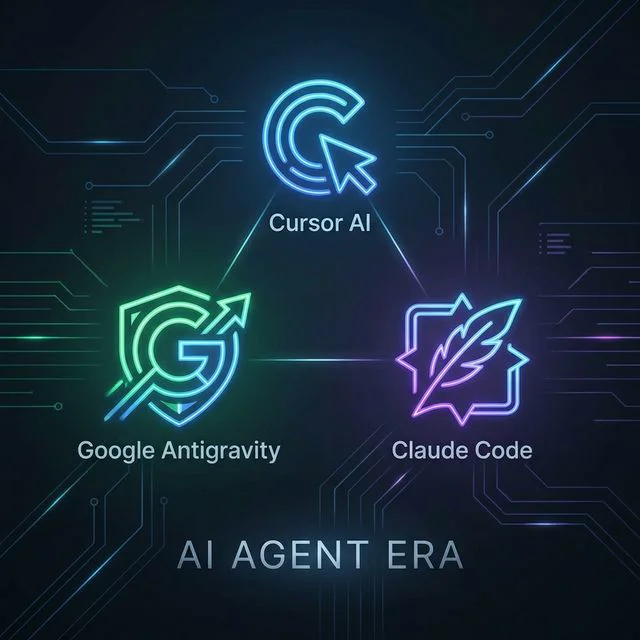
A comprehensive yet accessible breakdown of the three leading AI coding agents in 2026 — comparing the Iron Man Exoskeleton (Cursor), the Engine-Room Mechanic (Claude Code), and Mission Control (Google Antigravity).
Back in 2023–2024, coding with AI felt like sitting next to a “polite whisperer” — you typed half a line of code and it suggested the rest, or you manually copied an error message into a chat window and pasted the answer back into your editor.
By early 2026, the game has fundamentally changed.
We have entered the era of Autonomous AI Coding Agents — digital engineers equipped with real hands and eyes. They no longer sit trapped inside a chat box: they open your project folders, refactor twenty files simultaneously, run terminal test suites, launch real web browsers to click buttons and inspect the layout, and self-correct when tests fail!
To make this crystal clear even if you aren’t a software engineer, imagine building software like constructing a skyscraper. Today’s three market leaders represent three completely different philosophies of work:
- Cursor AI: An Iron Man exoskeleton worn directly by the master craftsman.
- Claude Code: An autonomous engine-room mechanic living inside the command line (Terminal).
- Google Antigravity: NASA Mission Control orchestrating a fleet of parallel robots.
Switch between the three paradigms in the interactive simulator below to see how their workflows compare:
Think of Cursor like an Iron Man suit worn directly by a craftsman. Your hands stay on the steering wheel inside a familiar workshop (VS Code), while an onboard radar (Embedding Index) maps every blueprint in your building and lets you remodel 5 rooms at once via Composer.
The Iron Man Exoskeleton (IDE Augmentation)
Best suited for: Interactive feature building & tight human control
Below is a deep dive into their technical architecture, economics, real-world benchmarks, and how they are reshaping software engineering.
1. Cursor AI: The Iron Man Suit Built Inside Your Familiar Workshop
Cursor AI maintains its massive popularity through a brilliant strategy: instead of forcing developers to learn a foreign interface from scratch, it forked VS Code (the world’s most popular code editor) and wired an AI brain directly into its nervous system.
A. The Invisible Blueprint Map (Embedding-based Indexing)
For non-specialists, imagine your software project is a 1,000-room hotel. If you ask a basic chatbot “Where does the third-floor bathroom pipe connect?”, it gets confused because it can only see the single room you currently have open.
Cursor solves this by running a silent background scanner that reads all 1,000 rooms and builds a Semantic Relationship Map (Embeddings). Using the @ symbol, you can summon any room, folder, or past renovation record into view. With a 272,000-token context window, it grasps complex system relationships effortlessly — though on massive corporate monorepos with hundreds of thousands of files, maintaining that map can still consume heavy system RAM.
B. Composer: Remodeling Five Rooms at Once
Composer transformed Cursor from an autocomplete tool into a true multi-file agent. When you ask to refactor an API endpoint, Composer updates the route definition, controller logic, unit tests, and documentation in parallel.
In early 2026, Cursor introduced parallel agent execution via git worktrees — letting you assign the exact same gnarly problem to both GPT-5.2 and Claude 4.6 Opus simultaneously in isolated sandboxes, then pick the cleanest solution!
C. Cursor Pricing & Economics
| Tier | Monthly Price | Key Capabilities | Best For |
|---|---|---|---|
| Hobby | Free | 2,000 Tab completions / month | Casual exploration |
| Pro | $20 | 500 fast requests, unlimited Tab, $20 premium credit pool | Everyday professional developers |
| Pro+ | $60 | $70 premium model credits, early access features | Heavy daily builders |
| Ultra | $200 | $400 model credits, top-priority compute queue | Power architects |
| Business | $40 / seat | Centralized billing, SSO, SOC 2 compliance | Engineering teams |
2. Claude Code: The Autonomous Engine-Room Mechanic (Terminal + MCP)
While Cursor polishes the graphical editor experience, Anthropic’s Claude Code takes the exact opposite route: it lives natively inside the Command Line Terminal (CLI), embracing the classic Unix philosophy of scriptable automation.
A. End-to-End Autonomous Execution
Claude Code doesn’t wait for you to hold its hand line by line. You give it a high-level goal in plain English: “Find out why checkout fails when a user applies an expired coupon and fix it.” It autonomously:
- Explores the repository structure.
- Formulates an execution plan.
- Edits the source files and runs the test suite in the terminal.
- Reads any error logs, adjusts its code, and repeats the loop until every test turns green!
B. The CLAUDE.md Rulebook and the Universal MCP Plug
Two foundational pillars make Claude Code a favorite among senior backend and DevOps engineers:
CLAUDE.md(Persistent Project Memory): Think of this as the laminated rulebook bolted to the workshop wall (“Never useanytypes, always run unit tests before finishing”). Claude Code reads this file at the start of every session so it never forgets your team’s architectural standards.- Model Context Protocol (MCP — “The USB-C Port for AI”): Before USB-C, every gadget required a different proprietary cable. MCP is USB-C for AI agents. With over 13,000 community MCP servers available, Claude Code can plug directly into Google Drive to read design specs, Jira to update tickets, or PostgreSQL to inspect schemas without a human ever copying and pasting text.
C. Claude Code Economics
| Economic Metric | Value | Why It Matters |
|---|---|---|
| Input Token Cost | $3.00 / 1M tokens | Reading codebase & logs |
| Output Token Cost | $15.00 / 1M tokens | Deep reasoning & code generation |
| Programmatic Tool Calling (PTC) Savings | ~37% | Batches multiple tool actions in one pass to slash API bills |
3. Google Antigravity: Stepping Into NASA Mission Control
Launched in late 2025, Google Antigravity represents a paradigm shift: moving from “AI assisting a human coder” to “a human architect managing an autonomous fleet of agents.”
A. Agent Manager & Parallel Workspaces
Antigravity splits your screen into two distinct worlds: a traditional Editor for manual tweaks, and the Agent Manager (Mission Control). From Mission Control, you can dispatch multiple asynchronous agents across isolated workspaces simultaneously — one agent fixing security vulnerabilities, a second building a new dashboard, and a third writing end-to-end tests.
B. Tangible Proof: Artifacts & Live Browser Control
How do you trust a fleet of autonomous agents working in the background? Antigravity solves the trust gap with Artifacts and Integrated Browser Control:
- Implementation Plan: Before touching critical files, the agent presents a structured blueprint for your approval.
- Live Browser Verification: Instead of asking you to manually test the UI, the agent spins up a real browser, visually inspects the rendered page, clicks buttons, fills out forms, and verifies that the feature actually works!
- Visual Walkthroughs: It hands you before-and-after screenshots and video recordings of its browser session as verifiable proof of completion.
C. Gemini 3 Benchmark Power
| Industry Benchmark | Gemini 3 Pro | Gemini 3 Flash | Real-World Meaning |
|---|---|---|---|
| SWE-bench Verified | 76.2% | 78.0% | Resolving real-world GitHub production bugs |
| LiveCodeBench Pro (Elo) | 2,439 | High | Solving brand-new competitive algorithm challenges |
| GPQA Diamond | 91.9% | 90.4% | PhD-level scientific and domain reasoning |
| MMMU-Pro | 81.0% | 81.2% | Multimodal understanding of UI layouts and diagrams |
💡 A Fascinating Discovery: Gemini 3 Flash — engineered for blazing speed and cost efficiency — actually beat the heavier Pro model on SWE-bench Verified (78.0% vs. 76.2%), proving that targeted reasoning distillation can make fast models extraordinary daily coding agents.
4. Head-to-Head Comparison: Which One Should You Pick?
| Dimension | Cursor AI | Claude Code | Google Antigravity |
|---|---|---|---|
| Everyday Analogy | Iron Man Exoskeleton | Engine-Room Mechanic | NASA Mission Control |
| Primary Interface | Graphical IDE (VS Code fork) | Command-Line Terminal (CLI) | Agent Manager + Live Browser |
| Autonomy Level | Medium (Interactive co-pilot) | High (Autonomous CLI loop) | Very High (Multi-agent fleet) |
| Context Architecture | 272k Embedding Index (1M Max Mode) | Context Caching + MCP | Native 1,000,000+ Token Window |
| Sweet Spot | High stability & fine-grained human control | Deep terminal automation & large refactors | Rapid parallel full-stack execution & UI testing |
5. “Vibe Coding,” AI Slop, and Essential Safety Rails
The rise of these agents gave birth to “Vibe Coding” — describing the high-level vision and “feel” of a product in plain language while letting AI agents handle the underlying implementation details.
Yet high autonomy comes with real hazards: “AI Slop” (bloated, hard-to-maintain code) and “Runaway Edits” where an overly eager agent modifies unrelated files or attempts to bypass directory permissions. That is why modern safety mechanisms — Cursor’s instant Snapshot Checkpoints, Claude Code’s deterministic Hooks, and Antigravity’s Review-Driven Approval Gates — are mandatory in professional workflows.
6. Conclusion: From Writing Code to Approving Architecture
The three-way race between Cursor, Claude Code, and Google Antigravity has permanently ended the era where a software engineer’s worth was measured by lines of code typed per day.
- Cursor gives you surgical precision when you want your hands on the controls.
- Claude Code gives you relentless, scriptable power inside the terminal.
- Antigravity gives you a mission control center to multiply your output across parallel agents.
The most effective engineers of 2026 and beyond aren’t competing against AI at typing speed — they are stepping up as System Architects who ask sharp questions, enforce strict quality guardrails, and orchestrate all three platforms to turn ambitious ideas into reality.